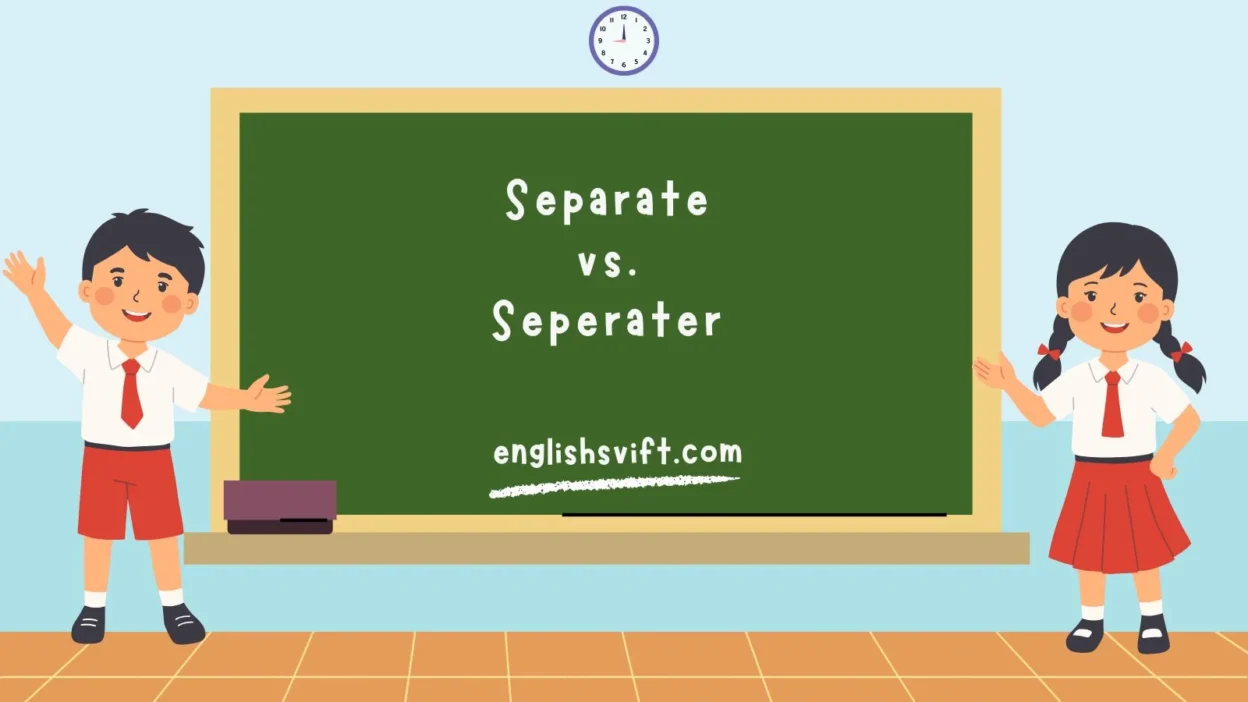
English learners, professionals, and even native speakers often get tripped up by one deceptively simple word: separate. The mistake usually shows up as “seperate”, which looks close enough to pass, but it’s always wrong.
This mix-up has puzzled students, writers, and even seasoned professionals. Why? Because the way the word sounds doesn’t always align with how it’s spelled. In this article, we’ll unpack the differences, offer memory tricks, and show how mastering this distinction boosts clarity, professionalism, and confidence in written communication.
Why Spelling Matters in Professional and Everyday Communication
Spelling may seem like a small detail, but it carries weight. Imagine submitting an official report, a resume, or even a classroom essay with “seperate” scattered throughout. The impression? Lack of attention to detail, reduced credibility, and a distracted audience.
Mark Twain once said:
“The difference between the almost right word and the right word is really a large matter—’tis the difference between the lightning bug and the lightning.”
The same applies to spelling. “Separate” is lightning; “seperate” is the bug.
The Correct Spelling: Separate (Not Seperate)
The word separate has three main roles in English:
- Verb: to divide or set apart.
- Adjective: existing as distinct, not joined.
- Noun: items of clothing that can be mixed and matched.
The misspelling “seperate” has no recognized use in standard dictionaries like Oxford, Merriam-Webster, or Dictionary.com.
Breaking Down Pronunciation: /ˈsep(ə)rət/ vs. /ˈsepəˌrāt/
The tricky part is that separate has two common pronunciations:
| Form | IPA Pronunciation | Example Usage |
| Adjective/Noun | /ˈsep(ə)rət/ | “They live in separate houses.” |
| Verb | /ˈsepəˌrāt/ | “The teacher will separate the groups.” |
This dual pronunciation leads many learners to spell it as “seperate,” since the middle vowel sounds like an “e.”
Why “Seperate” Exists and Why It’s Always a Misspelling
“Seperate” exists for one reason: phonetics. The spoken form tricks the brain into writing it the wrong way. But no major dictionary lists “seperate” as a legitimate spelling. It remains an error in academic, professional, and casual writing.
Etymology: From Latin Separatus to Modern English
- Latin Root: separare (“to divide, set apart”).
- Middle English: adopted as separaten.
- Modern English: shortened to separate.
The root word “separatus” (meaning set apart) explains why the “a” belongs in the middle.
Grammar Role: Separate as a Verb, Adjective, and Noun
| Function | Example Sentence | Explanation |
| Verb | “They had to separate the papers into piles.” | Action of dividing. |
| Adjective | “He packed separate bags for the trip.” | Describes distinct items. |
| Noun | “She bought suit separates for work.” | Clothing items designed to be worn individually. |
Visualizing the Spelling: Mnemonic Devices and Tricks
Memory tricks help learners and professionals avoid misspelling:
- Think of “a rat” in “sep-a-rat-e.”
- Visualize a symmetrical arrangement: the “a” balances the word.
- Create a mental image: “Always keep the a to avoid an error.”
“A Rat” in Separate: The Memory Reinforcement Hack
A classic mnemonic:
“There’s always a rat in separate.”
This visual cue helps students, native speakers, and professionals anchor the spelling in memory.
Common Spelling Errors: Seperate, Seperated, Seperately
Frequent mistakes include:
- Seperate instead of Separate
- Seperated instead of Separated
- Seperately instead of Separately
| Incorrect | Correct |
| Seperate | Separate |
| Seperated | Separated |
| Seperately | Separately |
Dictionary Guidance: Oxford, Merriam-Webster, and Dictionary.com
All major dictionaries reject “seperate.” Even Dictionary.com (often cited by students and writers) confirms that “seperate” is a misspelling.
British vs. American English: Does the Spelling Change?
Unlike words such as color/colour or organize/organise, the spelling of separate does not change between British and American English. “Seperate” is incorrect everywhere.
Separate vs. Seperate Meaning in Different Contexts
Some learners mistakenly think “seperate” might have a different meaning. It doesn’t. The only correct word is “separate.”
Synonyms and Alternatives: Words Alike but Not Identical
| Synonym | Usage Example |
| Split | “They split the bill.” |
| Divide | “Divide the class into groups.” |
| Partition | “The office uses glass partitions.” |
| Detach | “Detach the form before submission.” |
| Isolate | “The lab isolated the sample.” |
Split vs. Separate: Subtle Nuances in Usage
While synonyms exist, “separate” often carries a formal or precise tone, making it preferable in official documents, legal agreements, and academic writing.
Figurative and Literal Meanings of Separate
- Literal: “Separate the laundry into colors and whites.”
- Figurative: “They decided to separate after years of disagreements.”
Separate in Legal Context: Separation vs. Divorce
In law:
- Legal Separation: couples live apart under a formal agreement but remain married.
- Divorce: legally ends a marriage.
| Term | Meaning |
| Separation | Marital status remains, but couples live apart. |
| Divorce | Marriage legally dissolved. |
Professionalism and Accuracy: Why Spelling Shapes Reputation
Spelling errors like “seperate” undermine professionalism, credibility, and trust. In workplaces and classrooms, they can signal carelessness or lack of proficiency.
Classroom Confusion: Helping Students and Learners Master It
Teachers often report that “seperate” is among the top spelling errors across grade levels. Reinforcement strategies—like mnemonics, spelling practice, and real-time correction tools—help learners overcome it.
Tips for Learners, Professionals, and Writers
- Read extensively to reinforce correct spelling.
- Practice writing regularly.
- Review common errors to avoid repeating them.
- Use spelling checkers like Microsoft Editor.
- Apply mnemonics for long-term memory.
Spelling Tools and Writing Assistance Software
Digital tools enhance accuracy:
- Microsoft Editor
- Grammarly
- Dictionary.com spelling suggestions
These provide real-time correction, preventing misspellings like “seperate” from slipping into final drafts.
Real-Life Examples: How Misuse Affects Clarity
- Coworkers in an office puzzled by an email with “seperate reports.”
- Students losing marks for “seperate” in exams.
- Writers risking professionalism by including “seperate” in published work.
Idioms, Sayings, and Expressions with “Separate”
- “Separate the wheat from the chaff.”
- “Separate ways.”
- “Separate issue.”
These expressions always require the correct spelling.
Common Mistakes in Written Communication
- Swapping seperate for separate.
- Using “seperate” in professional documents.
- Misunderstanding verb vs. adjective forms.
Tables of Usage Examples: Correct vs. Incorrect Forms
| Incorrect | Correct | Sentence |
| Seperate | Separate | “Please separate the files.” |
| Seperated | Separated | “They separated the duties.” |
| Seperately | Separately | “Submit the forms separately.” |
Enhancing Communication Skills with Accurate Grammar
Clarity, precision, and correct grammar enhance trust, readability, and reputation. Correct spelling of words like separate reinforces professionalism in every interaction.
Final Tips for Mastering “Separate”
- Always remember: There’s a rat in separate.
- Use tools and practice frequently.
- Read aloud to reinforce proper spelling.
- Trust dictionaries, not how a word “sounds.”
FAQs
What is the correct spelling: separate or seperate?
The only correct spelling is separate. “Seperate” is always incorrect.
Why do people misspell separate as seperate?
Because of how it’s pronounced. The middle vowel sounds like an “e,” misleading learners.
Does British or American English accept “seperate”?
No. Both use “separate.” “Seperate” is a misspelling everywhere.
How can I remember the correct spelling?
Use the mnemonic: There’s a rat in separate.
What’s the difference between separate and divorce?
Separation means living apart but still married; divorce legally ends the marriage.
Conclusion
The confusion between separate and seperate highlights how spelling, pronunciation, and memory tricks intersect in language learning. While “seperate” may sound right, it’s never correct. From classrooms to professional offices, using the right form—separate—ensures clarity, credibility, and effective communication.
By applying mnemonic devices, reviewing examples, and practicing attentively, learners and professionals alike can avoid this common pitfall. Remember: separate is correct, seperate does not exist.